AirBeagle

Since 1963.-ish. At around 6:12 a.m.

AirBeagle

A suite first flight: AA A321-XLR Debuts

A suite first flight: American’s new Airbus A321XLR debuts on transcontinental route

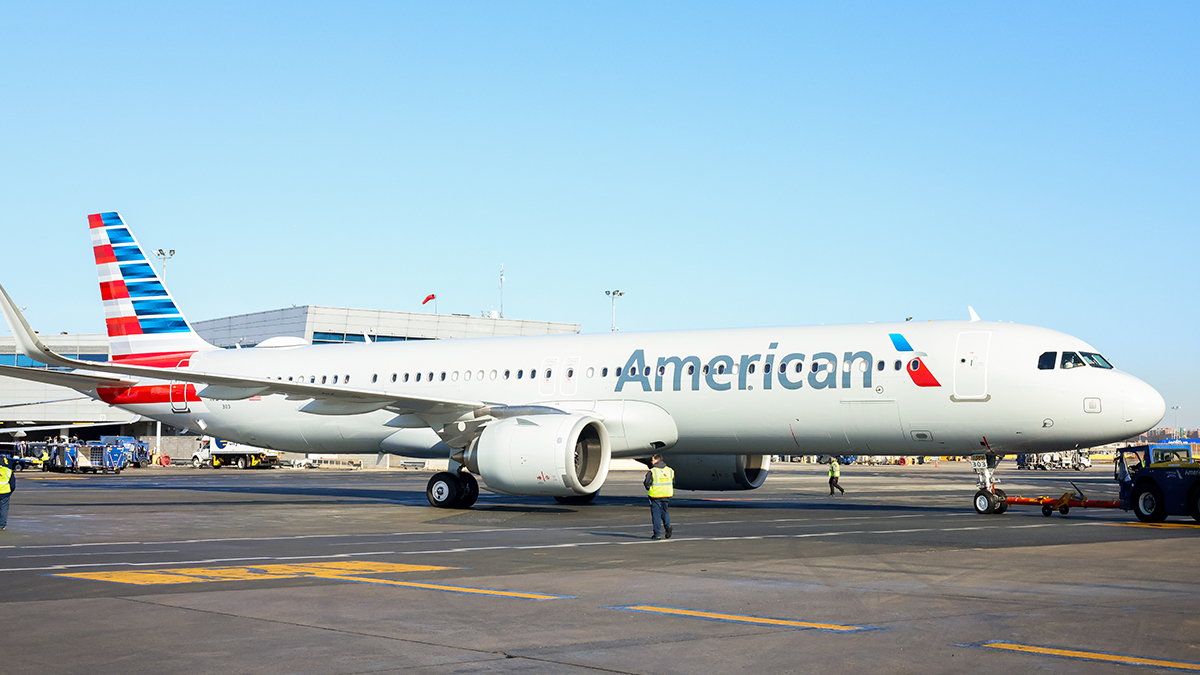
    • Departing at 11 a.m. ET, American’s new Airbus A321XLR flew its first flight from New York’s John F. Kennedy International Airport (JFK) to Los Angeles International Airport (LAX).
    • American is the first U.S.-based airline to operate the A321XLR, which offers customers Flagship Suite®, Premium Economy and Main Cabin experiences.
    • Starting next spring, the airline plans to operate the A321XLR on routes between JFK-Edinburgh (EDI), JFK-San Francisco (SFO) and Boston (BOS)-LAX.

    FORT WORTH, Texas — American has elevated transcontinental travel today with the inaugural flight of its Airbus A321XLR, carrying more than 150 passengers between New York’s John F. Kennedy International Airport (JFK) and Los Angeles International Airport (LAX). As the only U.S.-based airline to operate the A321XLR, the aircraft is a class above the rest, offering customers a Flagship Suite®, Premium Economy and Main Cabin experience.

    Customers on the inaugural received a gift bag that included a specially designed flight tag to commemorate the aircraft’s first transcontinental flight.

    “We’re excited that you’re here today to celebrate the debut of this new aircraft to our fleet, American’s Chief Customer Officer Heather Garboden said in a note to passengers on Flight 3. “From premium design details to Bluetooth connectivity to elevated entertainment, every feature on this plane has been thoughtfully crafted so you can enjoy transcontinental travel in comfort.”

    As American takes delivery of additional A321XLR aircraft, the airline will schedule the aircraft on its transcontinental routes between Boston (BOS)-LAX and JFK-San Francisco (SFO) for service starting early next year. This additional transcontinental service will complement new service between JFK and Edinburgh, Scotland (EDI), that will launch on the XLR on March 8, 2026.

    Departure airport Arrival airport Service start date
    Boston (BOS) Los Angeles (LAX) July 2, 2026
    New York (JFK) San Francisco (SFO) May 7, 2026

LOT Polish Airlines replaces its regional fleet

LOT Polish Airlines replaces its regional fleet for a more sustainable future with a higher focus on the environment

  • Airbus, the leading aircraft manufacturer, has been selected by LOT Polish Airlines as the supplier of 84 planes for its regional fleet.
  • The decision will be of great strategic importance not only for Poland’s national carrier, but also for the entire aviation industry in the region, as it generates a measurable economic stimulus.
  • The contract signed with Airbus allows LOT Polish Airlines to pursue the objectives of its corporate social responsibility strategy, as the new aircraft will offer an even higher level of comfort, while being more fuel efficient and emitting less CO2.
LOT Polish Airlines has signed a contract with Airbus – the leading aircraft manufacturer – to supply 84 A220 planes in their -100 and -300 variants. The process of replacing the regional fleet operated by LOT Polish Airlines is not confined to mere technical modernisation – it also provides the carrier with a viable opportunity to boost its competitiveness and account for growing passenger volumes. Thanks to the newly acquired airframes, the airline will be able to continue its expansion and will focus on moving its operations, in the long term, to Poland’s new hub – Centralny Port Komunikacyjny (CPK).
By offering a higher average number of seats, the new planes will allow the airline to utilise its slots in a more efficient manner. The carrier’s operating flexibility and emissions per passenger will be improved as well. All these factors play a crucial role in the era of increasingly stricter sustainability and environmental requirements.

The choice of its regional fleet supplier is of great significance for LOT Polish Airlines. It is the regional fleet that plays the role of a foundation stone of the airline’s operating model. By opting for Airbus A220 aircraft, we will improve our cost efficiency. The range of aircraft we operate will be limited to two state-of-the-art types, our flight planning and operational processes will be simplified, and maintenance costs will be optimised. While offering a higher level of comfort for our passengers, the planes will also be more fuel efficient. Their lower CO₂ and noise emissions, in turn, will allow us to successfully compete with other carriers.
—Maciej Dziudzik, Proxy, Fleet Office Director, LOT Polish Airlines

Modern fleet, sustainable flights

The A220 has been designed with short- and medium-haul flights in mind. It is a modern regional jet with a capacity of 100 to 160 passengers, depending on the specific version. With a maximum range of up to 6,700 km, it will be able to serve all connections within LOT Polish Airlines’ European flight network. The A220 uses up to 25% less fuel (per passenger) than older generation jets offered by the same manufacturer.

It relies on the fly-by-wire technology – a modern solution in which traditional mechanical connections between the pilot and the machine’s control surfaces are replaced by electronic interfaces. The design relies on highly advanced materials, such as carbon composites as well as aluminium and lithium alloys. The A220 embodies the latest generation of Airbus narrow-body aircraft, combining state-of-the-art aerodynamic solutions, sophisticated materials and the latest generation of Pratt&Whitney’s PW1500G engines.

Viable opportunity for an economic stimulus in the region

The choice of the new regional fleet supplier will be of great strategic importance not only for Poland’s national carrier, but also for the entire aviation industry in the region. A contract of such proportions offers a real chance for a meaningful economic stimulus, as it involves high-value investment and technology transfers, simultaneously allowing to expand the range of competence available domestically. Cooperation with Airbus will also affect Poland’s local aviation industry by boosting employment levels, increasing demand for R&D activities and facilitating economic relations with suppliers.
Airbus is currently employing more than 800 highly qualified staff at three locations in Poland: in Warsaw, Łódź and Gdańsk. The company is actively cooperating with 50 Polish suppliers, contributing to approximately 10,000 jobs. The manufacturer also plans to establish its digital hub in Poland, potentially creating, over a period of 15 years, up to 13,000 more openings.
The first aircraft will be acquired by LOT Polish Airlines in 2027, commencing the process of consolidating the carrier’s regional fleet. Once the older generation jets have been withdrawn from use, it will be made entirely of the Airbus A220-100 and 300 planes, facilitating the network planning process and ensuring improved operational efficiency.

Lufthansa Upgrades A320 Fleet for 4D Flight Path Data

Real-time flight path data supports more efficient use of airspace: Lufthansa Group upgrades Airbus A320 fleet

For greater efficiency and lower CO₂ emissions: Lufthansa Group is retrofitting its existing Airbus A320 fleet to optimize flight routes. Starting in 2026, 134 Airbus A320s will be equipped with the FANS-C digital communication system. The ADS-C EPP (Automatic Dependent Surveillance – Contract Extended Projected Profile) technology automatically transmits 4D flight path information – i.e., data on position, altitude, direction, and time – to air traffic control in real time. This allows flight routes to be better adapted to actual conditions in the air. The result: more fuel-efficient flight routes, lower CO₂ emissions, and greater punctuality.

The new technology is already in regular use in Maastricht airspace (MUAC), which is the first airspace in Europe to meet all the requirements for this. The Lufthansa Group is working with other air traffic control authorities to ensure that fuel-efficient flying can be implemented as quickly as possible in more and more European airspaces. This includes, for example, flight trials in collaboration with French air traffic control. From 2028, the new technology must be installed ex-factory in all newly delivered aircraft and ATC ground systems in the EU. With the complete retrofitting of its existing A320 aircraft, the Lufthansa Group is exceeding legal requirements and is once again leading the way in the introduction of innovative technologies. Nearly 200 retrofitted and upgraded aircraft of the A320 family will be in service for the Lufthansa Group in 2028.

“We are focusing on digitalization to make flying even more efficient. The retrofitting of our Airbus A320 fleet is a strong sign of innovation and responsibility. We are delighted that the EU is taking this step together with us. Only if all partners in the industry make their systems fit for the future in time will Europe soon be able to benefit from a better-connected and thus more sustainable airspace,”
—Grazia Vittadini, Chief Technology Officer of the Lufthansa Group.
Retrofitting the existing fleet as the next logical step 
The new technology for transmitting flight path information in real time automatically transmits 4D flight path information generated by the aircraft’s flight management system to air traffic control at any time. This so-called 4D flight trajectory describes the further course of a flight in three spatial dimensions (latitude, longitude, and altitude) and time as the fourth dimension. Based on this more precise information about the further flight path of an aircraft, air traffic control can manage airspace more efficiently and optimize the aircraft’s route.

Back in 2024, the Lufthansa Group decided to equip all new additions to its A320neo fleet with FANS-C technology and is now taking the next logical step by retrofitting its existing fleet. The measures are being supported by the European Commission with up to 50 percent funding as part of the Connecting Europe Facility (CEF) program. The new technology is currently certified for aircraft in the Airbus A320 family and the Airbus A330neo.

Important building block for forward-looking flight path optimization 
ADS-C EPP technology is an important first step toward implementing the Trajectory Based Operations concept, which aims to enable dynamic adjustment and optimization of flight paths in daily operations with the participation of all system partners involved. The Lufthansa Group has made its implementation a strategic priority. The retrofitting of more than 130 aircraft in the Group’s fleet is one of a wide range of measures taken by the Lufthansa Group to increase fuel efficiency in flight operations and underlines its commitment to more sustainable aviation.

Five levers of the Lufthansa Group for more sustainable flying 
The continuous improvement of fuel efficiency in flight operations, combined with fleet modernization, the use of sustainable aviation fuels (SAF), a wide range of options for private travelers and corporate customers for more sustainable flying, and the expansion of intermodality, is one of five levers with which the Lufthansa Group is promoting more sustainable flying. In addition, the Lufthansa Group has been actively supporting global climate and weather research for more than 30 years.